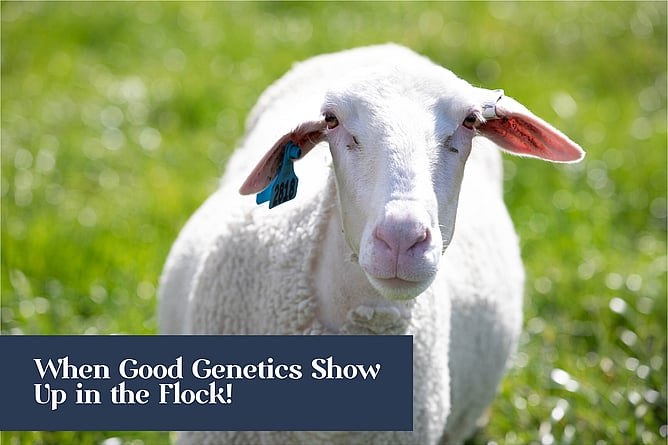
When Good Genetics Show Up in the Flock
Good genetics are not always obvious at first. Sometimes it takes several years, careful recording and a few generations before you can really see the difference they make. Our Southern Cross genetics programme has been developing over many years, and we are now seeing some exciting examples of those genetics showing up in commercial flocks.
Tap Tap: A Standout That Started the Story
Early in our genetics expansion phase, one of our supply farmers installed milk meters and soon noticed a particular ewe consistently standing out from the rest of the flock. In February (2023), she was still producing around 3 litres a day, while the flock average was less than 1 litre. She also had a nice udder conformation and good temperament. Naturally, we wanted to know more. What was her breeding? Where had she come from? And what genetics were behind such an exceptional performer?
After going back through our records, we discovered she was the granddaughter of Tap Tap, one of the early standout ewes in our Southern Cross genetics programme. Tap Tap was born in 2017 from our first French genetics import. She was one of the ewes selected to represent the genetics we were developing at our genetics farm integration. Peter, one of our genetics team founders, gave her the name Tap Tap. She was one of the last ewes to be named, and the joke at the time was that she might need a quick "tap" on the head if she didn't perform. Time showed that Tap Tap must have taken that as a challenge.
Tap Tap went on to establish a strong production record. In the 2018/19 season, she recorded 376 litres, with the figure calculated over 171 days. She continued to feature in our records as a strong-performing ewe before eventually moving into the multiplier flock after four successful seasons, giving her genetics the opportunity to help establish more suppliers.
Following the Family Line
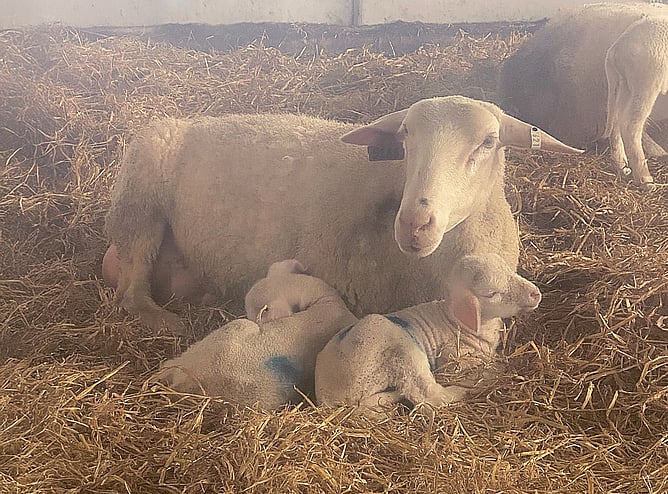
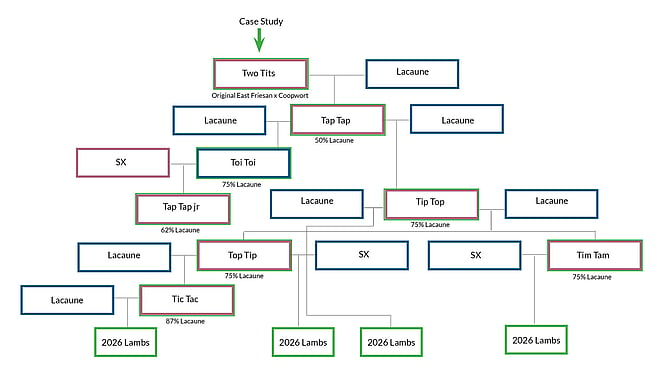
The next generation is where this story becomes especially interesting. One of Tap Tap's descendants, Tip Top, has also demonstrated strong milk production within the flock. In 2023/24, her estimated production in the first 105 milking days reached 374 litres, and she milked for 187 days. After raising her two healthy ewe lambs, Top Tip and Tim Tam (See above), she produced 3.69 litres per day during a flock test. She ranked among the top 20 ewes overall, placing her in the top 5%, and her two ewe lambs were growing well, reaching 50kg for mating at 8.5 months.
Tap Tap was an early standout in our Southern Cross genetics programme, and years later, we are seeing strong production continue through her descendants in a commercial supply flock. It is a practical example of how the genetics we have been developing can carry forward through generations and show their potential in different flocks. And the story is still continuing. In the 2026 lambing scans, four descendants of Tap Tap were scanned carrying lambs. We look forward to following these sheep and seeing how the Tap Tap family line continues to contribute to the Southern Cross® Genetics programme.
Woolma: Building a Family Line
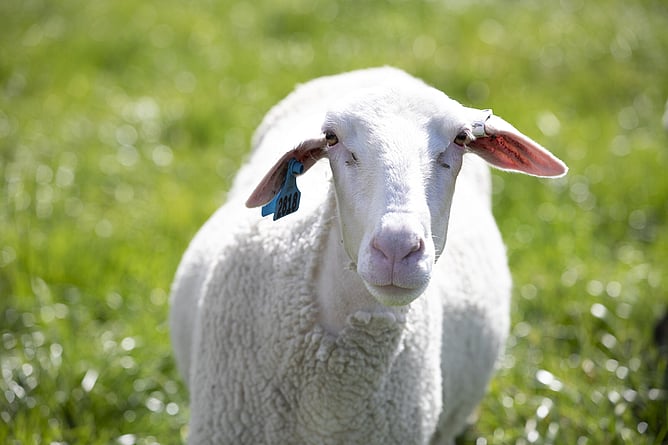
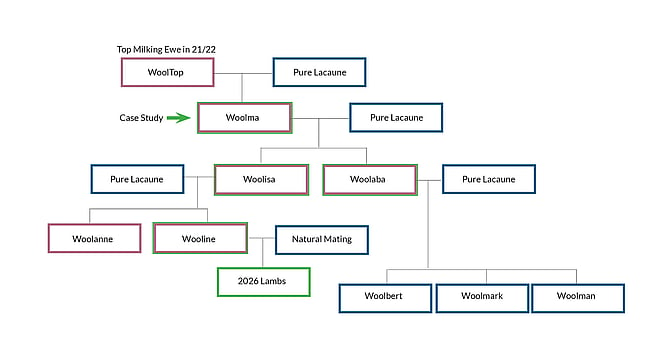
Woolma is another example of the type of ewe we want to build a flock around. She was selected as the subject of this story because she has featured in many of our marketing images over the years, giving us a ewe we could easily identify and follow through her records. Born in 2019, Woolma was 75% Lacaune and 25% East Friesian. She also came from a productive family line. When we looked further into the family records, Her mother, Wooltop, was identified as the top milking ewe in the 2021/22 season within the initial coopworth x East Friesian cross ewes before we earned access to Lacaune genetics.
From her first lactation in 2020/21, Woolma showed a combination of production, consistency and good temperament. After lambing on 31 August 2020, she produced 2.8 litres per day, finishing with an estimated 228 litres over 113 days. The following season she stepped up again. In 2021/22, she produced up to 4 litres per day, with an estimated 359 litres over the first 105 days of milking, and milked for 146 days. She ranked among the top 20 ewes that season.
In her third season, Woolma continued to show her ability. She lambed with twins on 22 August 2022 and peaked at 4.6 litres in October. Her estimated production reached 374 litres over 105 days, and she milked for 187 days. Across three seasons, Woolma demonstrated the traits we value in a breeding ewe: production, consistency, resilience and longevity. But her story doesn't finish with her own production.
Two of Woolma's daughters, Woolisa and Woolaba, have continued her family line. Woolisa has already produced two daughters of her own, while Woolaba has produced three sons who are currently part of the breeding group.
The family tree shows how these genetics are continuing to move through the flock, generation after generation. The story is still developing. Wooline, one of Woolisa's daughters, has been scanned pregnant for the 2026 season, giving us another generation to follow as this family line continues.
We look forward to seeing what these next generations can contribute and adding to Woolma's story as their own production records develop.
What These Stories Tell Us
These stories are not finished. They are still developing. The average ewe today is producing around 2 litres per day, depending on where she is in her lactation cycle. But as the genetics in the flock continue to improve, we are seeing ewes that are consistently producing between 300 and 400L per lactation, with or without rearing lambs, and we are aiming to multiply this type of sheep.
That is why a genetics programme matters.
It is not about expecting every ewe to be exceptional. It is about identifying the animals that are, understanding what is behind them, and then using those genetics to build the next generation. Tap Tap's family shows how a standout ewe from the early days of the programme can still influence today's supply flocks. Woolma's family shows how strong genetics can continue through daughters, granddaughters and sons entering the breeding programme. These are real animals, from real flocks, showing what can happen when good genetics are identified, recorded and carried forward.
The goal is not just to find the best ewe in the flock. It is to build a flock where more of those exceptional ewes can be found.